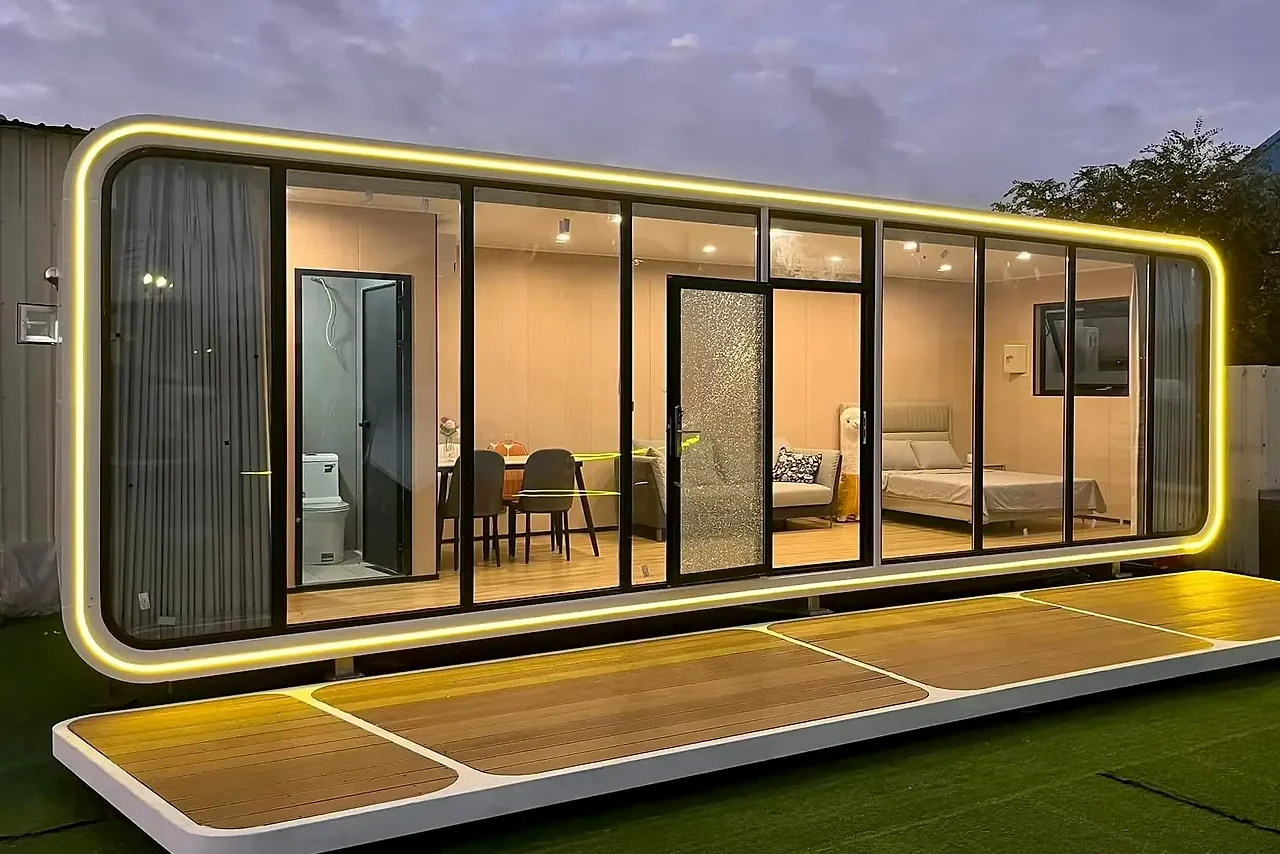
Portable cabin built to be lifted again and again
A portable cabin is a steel-framed box that arrives finished, is forked or craned onto blocks and is in use the same day, with the wall build-up chosen for storage, a workshop or an office.
- Lifting points and a braced deck for the move to the next compound.
- Forklift pockets and corner posts, so a telehandler places it where a crane cannot set up.
- Single-skin for storage and an insulated panel for a mess room, on the same frame.
- Forked off the lorry in the morning and locked up in use by the afternoon.
- Joins end to end with a gasket and bolts, so two cabins make one room.
Choose a configuration
A portable cabin is a steel-framed box that arrives finished, is forked or craned onto blocks and is in use the same day, with the wall build-up chosen for storage, a workshop or an office.
A welded box with pockets for the forks
The body is a welded steel frame with a plywood deck and forklift pockets under the floor, so it can be moved by telehandler where a crane has no room to set up. Corner posts take the load, which lets cabins sit side by side or one on another on a level hardstanding without an extra frame. The body is built on a light-gauge galvanised steel, with the pockets welded under the deck.
Single skin or insulated, chosen for the job
A store can be single-skinned with high-level vents, while a cabin used as an office or mess room needs an insulated panel so people inside are not sitting in condensation. The difference shows in the wall thickness and in whether the roof has a lining, and it decides how the cabin behaves through a cold snap.
One room that can be a store, a workshop or an office
The plan is a clear rectangle with the door on the long side or in the gable, so racking, a bench or desks can be set out without cutting the shell. Windows and a second door go where the panel joints allow, which keeps the frame intact and a late change cheap. Typical uses include offices.
Power for a workshop, light for a store
A cabin can arrive with a small consumer unit, LED battens and a row of sockets, or as a bare shell with one supply point for the site electrician. Anything with a motor or a heater is listed before production, because cable size and protection follow the load rather than the other way round.
Off the lorry, onto blocks, levelled
The cabin is lifted or forked off the lorry onto blocks, sleepers or a slab, then levelled with packers so the door still closes after the ground settles. Nothing is built in on site, so the cabin is usable the same day and can be moved again when the compound changes.
Anchored, ventilated and hard to walk off with
On an open site the cabin is tied down with ground anchors or ballast, and the gap under the floor is left open so air moves and the deck does not rot. Security comes from the door and shutter detail rather than the padlock alone, and the hinges are the part to look at first.
| Structure | light-gauge galvanised steel |
|---|---|
| Colors | Custom colours |
Included as standard
- Structural steel module
- Insulated wall and roof panels
- Doors and windows
- Electrical rough-in
- Interior finish
- Flooring
Typical lead time: production 4–8 weeks, freight 3–6 weeks depending on destination port.
What does a portable cabin need to stay secure when it is left locked?
Security is a set of small details specified up front: solid panels rather than glazing on the blind side, a shrouded hasp and a latch that cannot be lifted from outside, plus a lockable box or tool cabinet bolted to the frame so it cannot simply be walked off. Tell your advisor what is kept inside overnight, and the door leaf, the hardware and the window film are chosen around that answer.
How does a portable cabin connect where there is no mains supply?
Off-grid working is planned at specification, not discovered on site: the unit can arrive with an inlet for a generator or an external feed, a board sized for the equipment you list, and the cable route left ready for it. Say what has to run — kettles, heaters, tools, work positions — and where you keep fuel or the cable drum, because that answer decides the inlet, the protection and the socket positions.
What wears out when a portable cabin is craned repeatedly?
The lifting hardware and the frame corners take the work, not the walls: the lugs, the weld lines and the corner detail are drawn as repeat-lift steel, while cladding edges and door frames are the parts expected to need a touch-up between moves. Ask your advisor for the lifting plan that belongs to your configuration, and have the slings checked at every move rather than only at overhaul.
How should a portable cabin be restrained on an exposed open site?
Restraint is a site decision, so it is designed rather than improvised: ground anchors, driven pins or concealed ballast each suit a different soil, and the chosen method is drawn with the pad positions and the clearance needed under the floor. Say whether the plot is open moor, a walled yard or a hardstanding, and check the restraint detail against local wind and site rules before the cabin arrives.
Is it worth keeping a portable cabin after the project ends?
Buying suits a programme with several phases or a yard you already control, because the same frame keeps travelling and a sound cabin holds value longer than hire costs. Hiring suits a single short assignment, and the trade-off belongs in your paperwork: your own unit needs a base, a connection and a place in the next phase, while a hired unit comes back as a logistics line.
How fast can a portable cabin be up and running?
Most units are placed on prepared footings and connected to power within a few days of delivery. Because the module arrives pre-fitted — walls, wiring, finish and flooring included — site work is limited to foundations and hook-ups. Count on 4–8 weeks of production plus 3–6 weeks of freight to your port, so order with your move-in date in mind.
Can the unit be moved to another site later?
Yes. The module is designed for crane lifting and road transport, so it lifts off its footings and travels whole whenever your project moves. That is the main advantage over a conventional extension, which can only be demolished.
Can a portable cabin be used as a workshop with machinery?
Yes, if the load and the power are declared before production: a bench, a compressor and a small machine have different starting currents and different floor loadings. The deck is strengthened where the machine sits, the board is sized for the motor, and the door width is checked against the largest item that has to go in. Dust extraction and a second door for long stock are easier to plan at drawing stage than to cut into a finished cabin.
Related models
Tell us your project.
We'll quote in 24 hours.
Tell us your site, timeline and configuration and we'll return a feasibility note, indicative budget and one to three recommended models.